Iowa's Banned Books and Don't-Say-LGBTQ Law in Public Schools
Ever since SF496 was signed into law back in May 2023, there has been confusion about what it requires. Now, three years later and after much litigation, there is more clarity on what this law means and how it impacts schools, parents, and students.
Three provisions of the law are harmful, especially for LGBTQ kids in Iowa's public schools: 1) book banning, 2) forbidding LGBTQ curriculum and instruction, and 3) outing some students as transgender to their parents even when students have good reasons not to want them to know.
In 2023, the ACLU of Iowa, on behalf of Iowa Safe Schools and others, filed a lawsuit, which is ongoing, to stop those provisions from taking effect. See a timeline of that litigation here.
While our litigation was able to block pieces of the law from taking effect for long periods, the court has most recently said the law can take effect while the case continues. But the court did put up some important constitutional guardrails on how it can be enforced in Iowa public schools at this time.
Below is a summary of what the court has said about these three harmful portions of the law.
1. A ban for grades K-12 for books containing descriptions or depictions of a sex act, with the specific exception of the Bible and other religious texts.
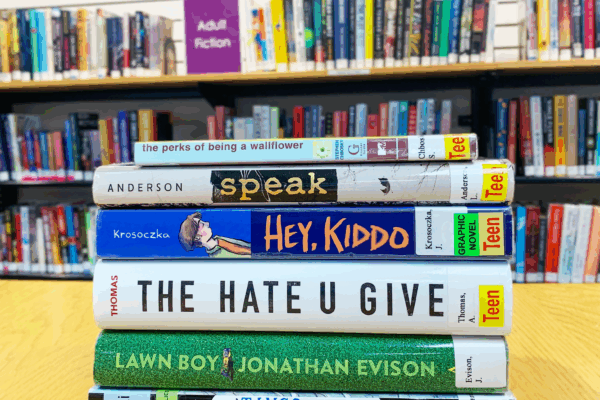
This language has, unfortunately, created much confusion. Some school districts have removed dozens or even hundreds of titles; some have removed just a few; and some have removed none. And some districts have now reshelved some of the books they originally removed.
Three years later, it is clear that this law should be applied only to books with detailed, explicitly written descriptions or visual depictions of one of six types of sexual contact, defined in another part of Iowa law, Iowa Code § 702.17(1)–(6). Quoting the text of the law, these are:
- “(1) penetration of the penis into the vagina or anus; (2) contact between the mouth and genitalia or mouth and anus or contact between the genitalia of one person and the genitalia or anus of another person; (3) contact between the finger, hand, or other body part of one person and the genitalia or anus of another person, except in the course of examination or treatment by a licensed physician; (4) ejaculation onto the person of another; (5) use of artificial sexual organs or substitutes therefore in contact with the genitalia or anus; and (6) touching a person’s own genitals or anus with a finger, hand, or artificial sexual organ or other similar device at the direction of another person.”
A book that does not specifically detail one of these six sex acts should not be removed. For example, a book that simply refers to characters engaging in oral sex but does not describe it in the detail set out in the law quoted above should not be removed. A graphic novel that features an image of a closed bedroom door with word bubbles indicating moaning isn't depicting what is happening behind that door and so should not be removed.
And even if a book is indeed covered by the law and can't be offered in school libraries, students can still bring it to school on their own, read it there, and discuss it at school.
When SF496 was first signed into law, many schools wrongly thought it banned books with LGBTQ characters or even books dealing with gender identity or sexual orientation as topics. Now, the state finally agrees the law cannot constitutionally do that. Schools may indeed make available books on gender identity, “gender theory,” or sexual orientation, and can make available books with LGBTQ themes or characters, to students of any grade.
Some examples of books that schools can offer would be All Are Welcome, which features an image of two male parents of a student, or Melissa, which tells the story of a child understanding their transgender identity.
2. A “don’t-say-LGBTQ” provision that forbids programs, "promotion," "curriculum," and "instruction," relating to "gender theory* or sexual orientation" in grades K-6.
Courts now have said this part of the law applies only to "mandatory curriculum." That means schools can’t teach or require a certain viewpoint or detailed explanation about gender theory or sexual orientation in grades K-6.
The law does not apply to anything that isn't part of the mandatory curriculum. Therefore, it doesn't affect:
- GSAs (student groups for LGBTQ students and their allies) and their promotion or activities, including posters, announcements, or events
- Books available for students' voluntary review—this would describe books available in the school library, as long as they aren’t assigned
- Pride flags, Safe Space, Everyone Is Welcome Here, and similar signs or displays
- Informal student-teacher discussions outside of class instruction time
- Teachers or students, during class and school activities, referencing their own gender identity or sexual orientation or that of friends and family members as long as it's not part of mandatory instruction.
3. A "forced outing" provision that requires teachers, counselors, and other staff to report a student to parents or guardians if the student asks to use a name or pronoun relating to gender identity.
The courts have said this means schools must tell parents when a student asks for them or others to use a name or pronoun specifically for the purpose of affirming a gender identity different from the sex assigned to them at birth.
But it does not apply to:
- Students who merely state or express their own gender identity. That could include their use of cultural indicators such as dress, hairstyle, speech, and other behaviors without making a specific "request" for an "accommodation" of some sort, such as being addressed by a different name.
- Students who ask to be called by a different name or nickname for reasons other than gender identity.
- A student who attends or speaks at a GSA.
If you believe your school is still using SF496 to ban books that it shouldn't, is wrongly restricting GSAs, limiting student free speech and expression, or otherwise restricting or penalizing expression by and about LGBTQ+ people and issues, we want to hear from you. Please contact us at legal.program@aclu-ia.org. It will be kept confidential.
*The wording of the law has changed from "gender identity" to "gender theory."
Related Issues
Related Content
A Timeline of Iowa's Banned Books/Don't Say LGBTQ Law