
Over the last several years, the presence of school resource officers (SROs) has increased by 23 percent in Iowa. Today, one-fourth of all Iowa school districts have an armed SRO patrolling the halls of their high, middle, and even elementary schools.
To quantify how schools and law enforcement oversee these programs, we launched into a one-year research project. We sent open records requests to 87 school districts, studied available federal data on racial and other disparities, and reviewed national studies on the topic. Our resulting report found outlines some disturbing trends:
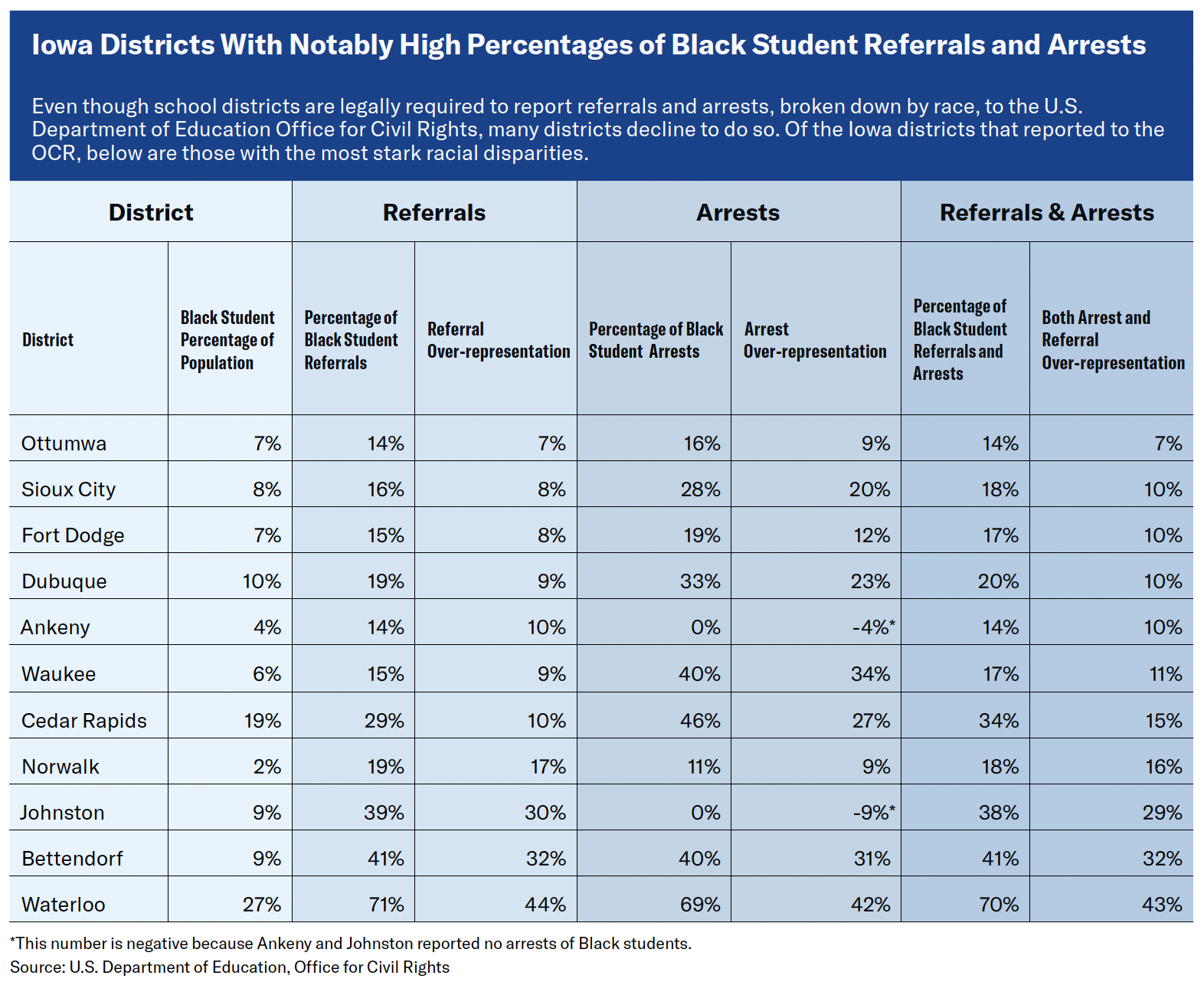
- Black students in Iowa are arrested at a rate 3.7 times higher than that of other students. They make up 7 percent of the population yet account for 21 percent of the arrests, even though other studies show that Black students do not misbehave or commit crimes at a higher rate. Waterloo, Bettendorf, and Johnston had the worst disparities for Black students.
- Students with disabilities make up 13 percent of the student population in Iowa, but account for 27 percent of SRO referrals and 26 percent of arrests. That means they are referred or arrested at 2.3 times the rate of students without disabilities.
- SRO programs in different districts are often poorly run, with oversight so inadequate that it can violate state and federal laws.
All this despite the fact that we can find no quality national data or study that shows that the hiring of an SRO actually keeps a student safer, even during tragic mass shootings.
But the data does show the many harms that SROs can create for students. Find out more about the study and the data here.
- For more details, go to our media release, here.
- To see the report in full, click here.
- To see a listing of the communities that are cited specifically in the report, often with problematic SROS programs, click here.
ACLU of Iowa Legal Director Rita Bettis-Austen said, “The stated goal is usually to keep students safe, and nothing is more important. But unfortunately, there is no high-quality evidence that police staffing in schools actually does increase student safety.
“Instead, research shows that having police in schools tends to create harm for many students. The presence of an SRO too often leads schools to respond to regular disciplinary and behavioral needs of students—which traditionally have been handled less harshly by schools and parents—by referring those kids to police. That can funnel kids—particularly Black students and students with disabilities—into the juvenile delinquency and adult criminal court systems,” Bettis Austen said.
If you or your child had a negative experience with an SRO, we want to hear from you. Please email us at legal.program@aclu-ia.org.