Des Moines, Iowa — Today the ACLU of Iowa released a report documenting the growing number of School Resource Officers (SROs) in Iowa and the many problems associated with their presence in high schools, middle schools, and even elementary schools.
Between 2018 and 2021, the number of SROs nationally has increased by 23 percent. In Iowa, the study found, there are at least 130 SROs in 78 Iowa school districts. Today, about one-fourth of all Iowa school districts have at least one SRO.
Rita Bettis Austen, ACLU of Iowa Legal Director, said, "SROs are police officers, who are often armed, and who are placed inside of schools where they interact with kids. Sometimes, those interactions are the result of a referral by the school to law enforcement as a juvenile delinquency or criminal justice matter, and other times, interactions may be casual with law enforcement ostensibly serving as mentors. The research shows while SROs are usually placed in schools to benefit school safety, that, unfortunately, isn’t borne out in outcomes. Instead, SRO programs create harms for many students by treating what would traditionally be handled through normal school discipline, or what is the result of a student’s disability and unmet educational support needs, as criminal or delinquent. While the harms can impact all kids, disproportionately these harms are being experienced by Black students and students with disabilities."
To conduct the study, the ACLU of Iowa hosted a dedicated legal fellowship with attorney Jacob Sarasin (pronounced SAIR-uh-sin), ACLU of Iowa Legal Fellow. He collected data from two main sources.
One source was an extensive series of open records requests sent to 87 school districts and 67 corresponding law enforcement agencies, for a total of 154. (You can view a listing of the schools here.)
Another main source was data collected from school districts by the U.S. Department of Education Office of Civil Rights (OCR).
"The district-by-district data obtained through open records requests was used to understand how SRO programs are operating at the local level," Sarasin said. "We relied on the OCR data to map overarching trends related to arrest and referral rates for different population groups," Sarasin said.
Additional information was also used to create the report, Sarasin says. "To contextualize the findings of the data we received, we conducted a thorough literature review of empirical studies on the effects of SROs in schools. We also looked to the excellent past work of ACLU National and our fellow ACLU affiliates from around the country, particularly our neighbor affiliate, the ACLU of Nebraska, whose impactful model we sought to replicate in Iowa."
- To see the report in full, click here.
- To see a listing of the communities that are cited specifically in the report, often with problematic SROS programs, click here.
- To see the actual open records responses from each school district, click here.
- To see a listing of what each of the studied districts reported to the OCR (number of referrals and arrests, broken down by race), click here.
Specific findings of the study are:
There is no evidence that SROs actually keep students safer.
A survey of national studies could not find a single one that clearly demonstrated that having an SRO keeps a school any safer than a school without an SRO, including during tragic school mass shootings.
In fact, there is evidence that SROs can actually create harm for students by escalating a minor incident into an actual criminal offense (or juvenile delinquency case) that can impact a young person their entire life.
Bettis Austen said, "The stated goal is usually to keep students safe, and nothing is more important. But unfortunately, there is no high-quality evidence that police staffing in schools actually does increase student safety.
"Instead, research shows that having police in schools tends to create harm for many students. The presence of an SRO too often leads schools to respond to regular disciplinary and behavioral needs of students—which traditionally have been handled less harshly by schools and parents—by referring those kids to police. That can funnel kids—particularly Black students and students with disabilities—into the juvenile delinquency and adult criminal court systems," Bettis Austen said.
"And when kids interact with and enter those systems, it often can leave a lifelong mark on them. For many, it causes trauma, depression, anxiety, and separation and isolation from family and other supports. The stigma associated with hostile police interactions, detentions, and arrests can result in an identity shift to being a 'bad kid," which all makes it more likely, not less, that a kid will struggle with ongoing adult problems and adult criminal justice involvement. That is the school-to-prison pipeline. We should instead be doing everything we can as a society to help protect our Iowa kids from those outcomes, to work to meet their needs, and to provide them with an educational environment that is truly safe," Bettis Austen said.
SROs disproportionately discipline and arrest Black students.
Black students in Iowa make up 7 percent of the population but account for 13 percent of referrals and 21 percent of arrests, even though national studies indicate that Black students do not actually misbehave or commit crimes in schools at a higher rate.
This means that a Black student receives a referral at twice the rate of other students. A Black student is arrested at 3.7—nearly four times—the rate of other students.
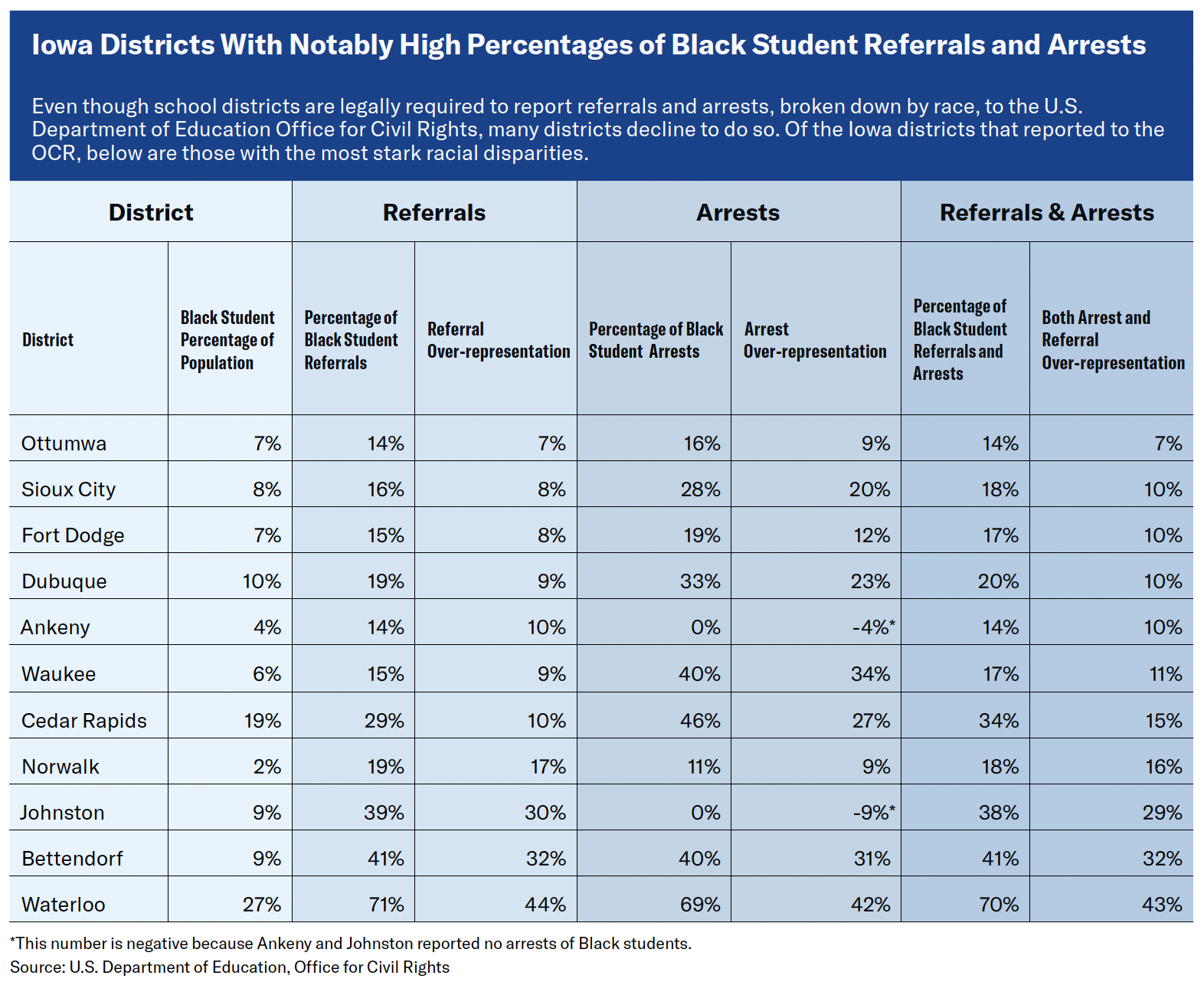
Of the districts reporting data to the OCR, some had racial disparities that stood out:
SROs also disproportionately discipline and arrest students with disabilities.
Students with disabilities make up 13 percent of the student population in Iowa, but account for 27 percent of SRO referrals and 26 percent of arrests.
That means students with disabilities are either referred or arrested at 2.3 times the rate of students without disabilities. This demonstrates a broad failure to adequately accommodate challenging behavioral and educational needs of some students with disabilities within schools by instead foisting them on law enforcement who don’t have the tools to respond appropriately.
SROs often discipline students, including those in elementary school, for minor infractions traditionally handled better by school officials.
For example, the study found that students being caught vaping either THC or nicotine is by far the most common reason for SRO intervention. Vaping does not require an armed police officer to address.
The incident reports filed by SROs are likewise filled with their involvement with students calling each other names, pushing, spreading rumors, and other minor offenses, including for students being “disrespectful” in class, and even causing “drama with a group of girls.”
None of these incidents violate any laws and do not warrant law enforcement involvement. Some examples:
- In Perry, in two separate incidents, the SRO was called in to handle a 7-year-old boy “who was running through the hallway and becoming agitated with staff.” In another, the SRO intervened because a 6-year-old was “trying to destroy a classroom” and “being physically disruptive.”
- In Pella, an SRO became involved in the investigation of a 10-year-old boy kicking a ball at a 9-year-old girl and shaking a climbing net she was on.
- In Sioux City, a student taking a bag of popcorn on his way out the door was investigated as theft.
- Also in Sioux City, four 14-year-old boys egged a house, not on school grounds. SRO records are unclear, but indicate the boys were investigated and possibly even charged with criminal mischief.
SROs come at a considerable financial expense to schools and communities.
The average cost of employing an SRO in Iowa is at least $98,000 (which may or may not include benefits beyond wages, expenses, and other costs). Costs are often shared between districts and law enforcement agencies, with some districts carrying a smaller or greater percentage of total costs. By way of comparison, the base average wage for a school counselor, who could potentially head off student behavior problems before they start, is $70,015; the average teacher wage is $66,655.
Police hired as SROs often have little to no training in dealing with children in a school environment.
The study found that 78 percent of school districts do not have special SRO training requirements beyond what all law enforcement would receive. And 58 percent of law enforcement agencies, who provide the SROs to the school districts, have no formal, specialized training requirement for these officers entrusted with children in a school setting.
Too few policies exist to make sure parents and guardians are notified when their child is questioned by an SRO.
Almost half—44 percent—of districts were unable to produce a policy for notifying parents or guardians when their child is expected to be or has been questioned by an SRO. Roughly a third of law enforcement agencies had no parental notification policy.
"Iowa law requires notification of parents when kids are held in custody and questioned for suspected serious or aggravated misdemeanors, or felonies,” Bettis Austen said. "But because an SRO is often posted in schools and regularly interacting with kids, kids and their parents potentially face a wide swath of unclear situations. With SROs, you may have police talking to and questioning kids at schools in ways that parents are never required to be informed about, before or after the interaction–especially for more minor behavioral issues not rising to the level of a serious misdemeanor. Most parents would want to know about those interactions and likely believe they would be informed, but this report found in many schools, no policy or law would require that."
Key Recommendations for Action
This report also makes a number of policy recommendations for school districts, law enforcement, and other leaders to take action.
"We want to support kids, parents, and schools with this report by giving them concrete information about what is happening here in Iowa and by suggesting reforms to address harms. This starts with eliminating SROs altogether. And if that’s not on the table in any local school district, schools can take other actions intended to safeguard students’ rights, ensure parents are informed and involved, and require better training, regular assessment of how SRO programs are or are not working in schools, and provide better accountability for problems," Bettis Austen said.
- Eliminate SRO programs. First and foremost, Iowa schools should follow the lead of other districts, such as Des Moines and Ames, who have done away with their SRO programs altogether because of the many concerns spelled out in this report.
That said, if school and law enforcement insist on continuing their SRO programs, they should implement the following important changes:
- Stricter training requirements for SROs so they are better equipped to deal with the special requirements of dealing with children in a school setting.
- More thorough reporting of SRO activities is critical to make sure that SROs are interacting with students appropriately, are not over-policing students of color and students with disabilities, and are not escalating minor behavior problems into criminal offenses.
- Measurable goals for an SRO program with regular monitoring and evaluation of those goals.
- Clear guidelines for SRO involvement, determining when it is appropriate for an SRO to become involved in a situation.
- Clear complaint procedures so that parents, students, and others know how to express concerns about an SRO program at their school.
School Districts Included in This Study
The following public school districts were sent Open Record Requests, submitted pursuant to Chapter 22 of the Iowa Code, for information about their SRO programs. All but two responded: Central Dewitt and New London.
Adel Desoto Minburn
AHSTW
Ames*
Ankeny
Atlantic*
Ballard
Benton
Bettendorf
Bondurant-Farrar
Boone
Boyden-Hull
Burlington
Camanche
Cardinal
Carlisle
Cedar Falls
Cedar Rapids
Centerville*
Central Dewitt
Central Lee
Cherokee
Clinton
College
Council Bluffs
Creston
Dallas Center-Grimes
Danville
Davenport
Dubuque
Durant
East Mills
Estherville Lincoln Central
Fort Dodge
Fort Madison
Glenwood
Humboldt
IKM-Manning
Indianola
Johnston
Keokuk
Knoxville
Le Mars
Linn-Mar
Maquoketa
Marion
Marshalltown
Mediapolis
Monticello
Muscatine
New London
Newton
North Cedar*
North Polk
North Scott
Norwalk
Okoboji
Oskaloosa
Ottumwa
Prairie City-Monroe
Pekin
Pella
Perry
Pleasant Valley
Riverside
Sergeant Bluff-Luton
Sidney
Sioux Center*
Sioux City
South Tama County
Southeast Polk
Spencer
Spirit Lake
Storm Lake*
Treynor
Tri-Center
Underwood
Urbandale
Van Meter
Vinton-Shellsburg
Wapello
Waterloo
Waukee
Waverly-Shell Rock*
West Branch
West Des Moines
Wilton
Winfield-Mt. Union
* Reported not having an SRO
Related Issues
Related Content
ACLU of Iowa Releases Advocacy Toolkit to Help Local Advocates Remove Police from Schools
Why school police officers may not be the most effective way to prevent violence
Stay Informed
Sign up to be the first to hear about how to take action.
By completing this form, I agree to receive occasional emails per the terms of the ACLU’s privacy statement.
By completing this form, I agree to receive occasional emails per the terms of the ACLU’s privacy statement.