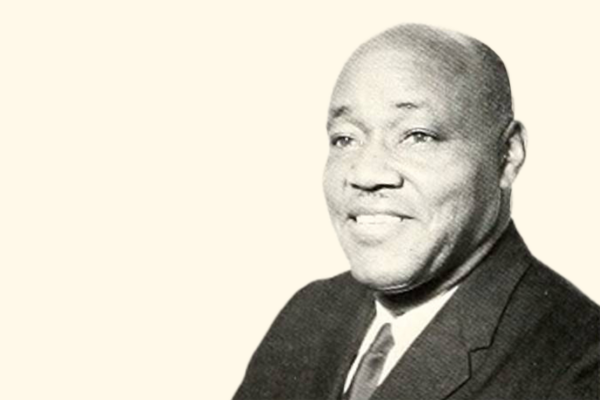
Thirty years ago, Dr. Ezra Totton—a distinguished chemist, civil rights trailblazer, and University of Iowa graduate—created a scholarship for Black science students at his alma mater.
But the UI recently sought to repurpose the scholarship for first-generation students instead. And in a case in which we participated, the Iowa Supreme Court ruled against that modification, saying that there was no evidence Dr. Totton would have supported that change.
To the contrary, all the relevant evidence demonstrated that Dr. Totton, a person who experienced racial discrimination throughout his life and worked to help advance civil rights and equal opportunities for Black people, would want the money to support Black science students in higher education.
Born in the Jim Crow South, Dr. Totton grew up under laws and practices that restricted where Black people could live, work, and learn. Despite these barriers, he graduated from Knoxville College, a historically Black college, in 1935. After serving in a segregated Army unit during World War II, he then applied to a chemistry graduate program at the University of Tennessee, but was denied admission because it banned Black students. In 1939, Dr. Totton was one of six highly qualified Black students who, with the help of the National Association for the Advancement of Colored People (NAACP), sued the school to challenge that discriminatory ban. They unfortunately were not successful in that lawsuit due to a now-overturned racist legal precedent.
But like the NAACP, Dr. Totton did not give up after the Tennessee decision. Wrongly excluded there, he pursued a master’s degree at the UI, a Ph.D. from the University of Wisconsin, and completed post-doctoral work at Stanford University. He later became the chemistry department chair at North Carolina Central University (NCCU), another historically Black university, and the chemistry building there now bears his name.
Eventually, in 1954, the work of the NAACP, Dr. Totton, and many others fighting school segregation around the country culminated in the landmark win, Brown v. Board of Education ruling.
When Dr. Totton passed away in 1996, he funded five scholarships to help Black science students. One was at the UI, another was at the University of Wisconsin and these had the express requirement that they go to Black students; two others were established at Knoxville College and NCCU, historically Black institutions he had attended and taught at. Another one assisted was for White Rock Baptist Church, the predominantly Black church which played a vital role in the civil rights movement in the South and where he and his wife attended for decades.
For decades, the UI honored his gift. But after a 2023 U.S. Supreme Court decision against affirmative action in admissions, Students for Fair Admission v. Harvard, the UI filed a legal action to change Dr. Totton’s private scholarship and give it to first-generation students instead.
While some Black students are also first-generation students, the two groups are not the same. At the University of Iowa, fewer than 3 percent of students are Black, while about 19 percent are first-generation. Changing the scholarship would have made it much less likely for Black students to benefit from it.
The district court denied the university’s request. The university appealed, and the Iowa Supreme Court decided that the university could not repurpose the scholarship for first-generation students and sent the case back to the district court for further proceedings. Details here.
The Iowa Supreme Court instructed the district court to:
- Allow an advocate for the donor's intent to participate in proceedings to determine how to change or redirect the scholarship moving forward.
- Consider the terms of Dr. Totton's will and other relevant evidence to ensure any changes to the scholarship are consistent with Dr. Totton’s wishes.
- Consider giving the money to another institution better able to distribute the money in keeping with Dr. Totton's wishes.
Dr. Totton’s legacy matters. He persevered in a time when universities themselves enforced racial segregation. One of his enduring acts was to open doors for Black students at his chosen institutions.
For this, he should be remembered and honored, and his gift preserved in accord with his wishes.
To read more about the Iowa Supreme Court decision, click here.